NDR Recovery · Live in Insights
An RTO isn't a fact. It's a claim nobody checked.
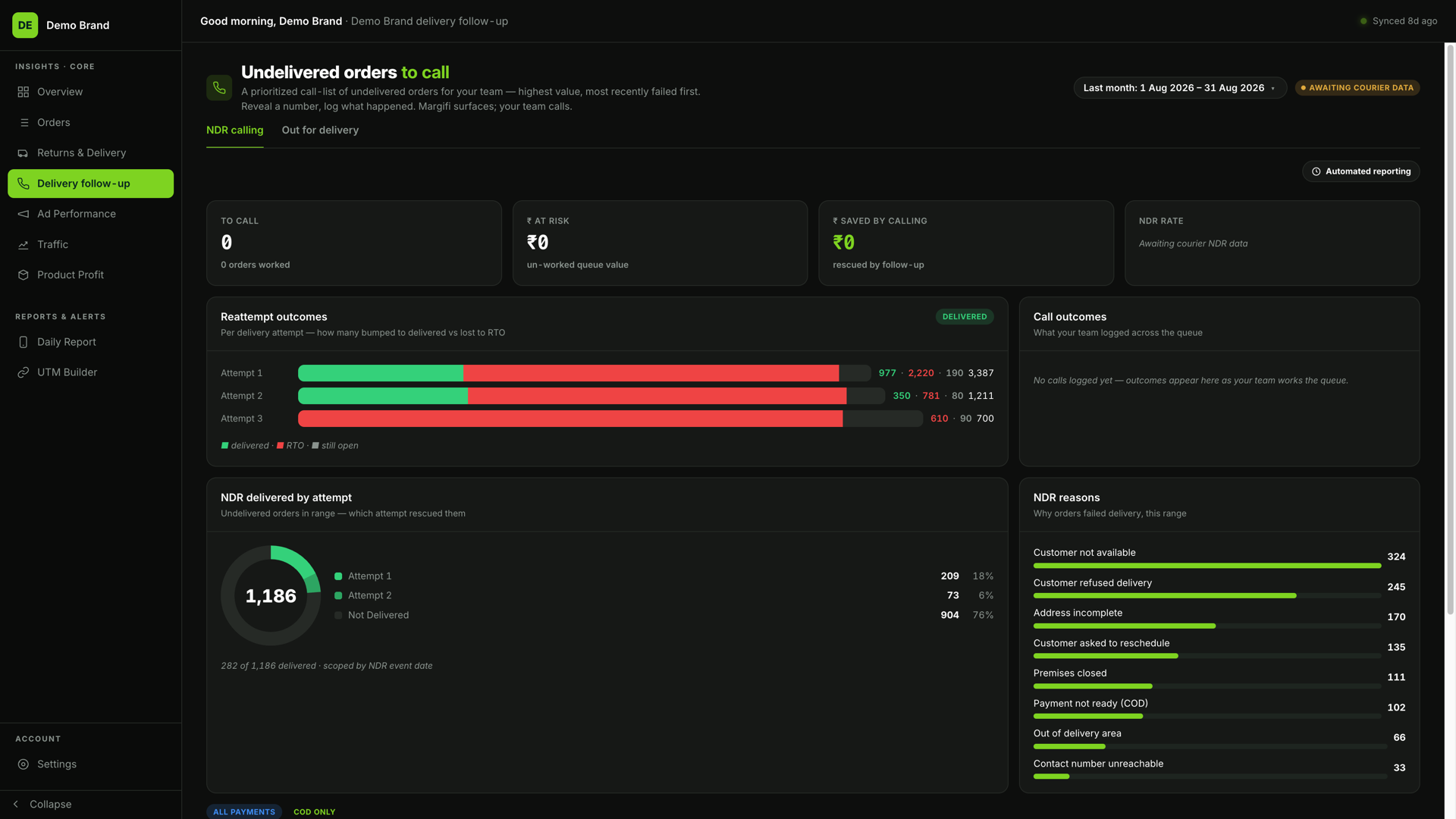
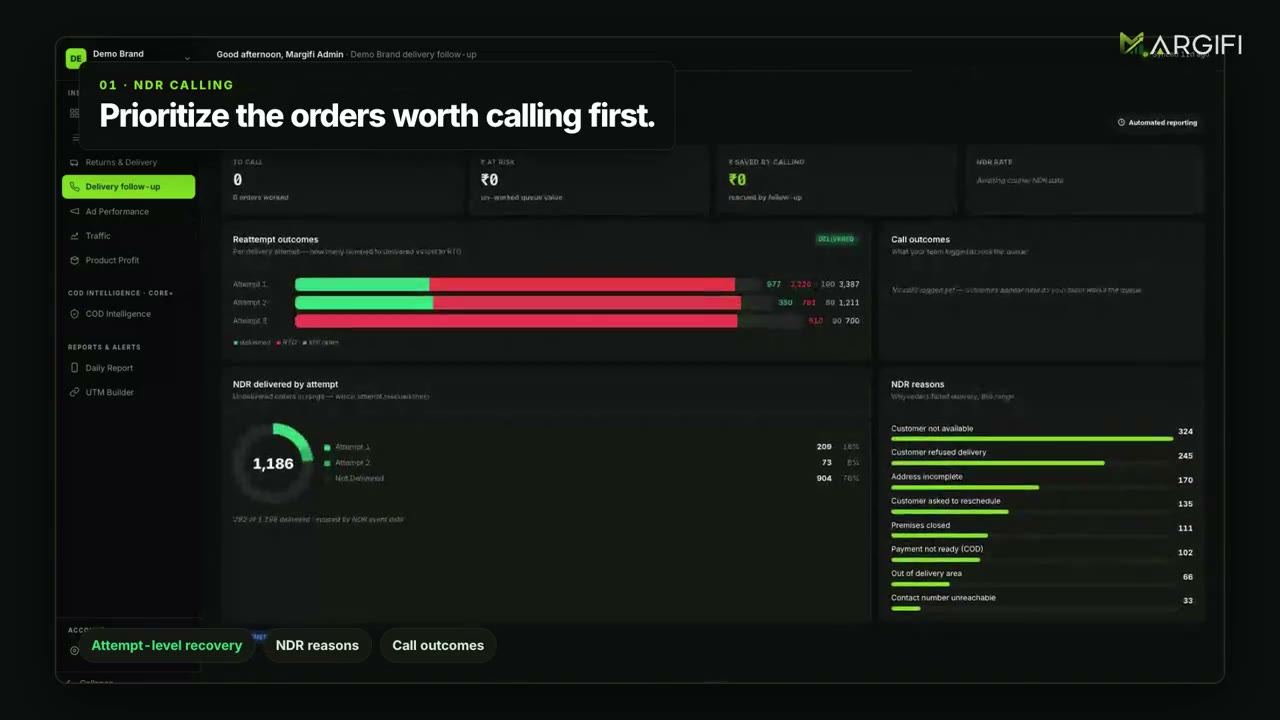
Couriers file non-delivery reports that don't match the doorstep. Margifi doesn't take the claim on trust — every undelivered order lands in one queue ranked by the money at risk, each row carrying the courier's own reason, its attempt count and when it last tried, so your team can call the customer inside the reattempt window.
- Part of Insights — nothing extra to buy
- Courier-confirmed, never estimated
- No pixel · no code
The leak
The RTO leg you pay for twice.
Every returned parcel is a stack of losses, not one: the ad spend that bought the order is already burned, the forward freight is spent, the reverse freight is billed on top, and the product comes back needing repackaging before it can sell again. Your ad dashboard counts the sale. Your bank counts the stack.
Real pilot brand, last 30 days, courier-confirmed. In-transit orders stay uncounted until the courier decides them — never estimated.
255 of 729 orders came back. A meaningful share of them were never really refused — they were non-delivery claims nobody called to check. That's the recoverable part.
Illustrative RTO journey — amounts vary by brand and courier; the stack doesn't. The ad money is gone either way.
The queue
A ranked call list, not another report.
Margifi ranks every undelivered order by the money at risk, so the ₹5,000 order gets called before the ₹800 one. Each row carries the courier's own account of the delivery — the reason it filed, how many attempts it logged, when the last one landed — beside the order value and whatever your team recorded the last time it called. Margifi doesn't judge the claim. It puts the courier's own record on the table so your team can.
- An NDR landsThe courier files a non-delivery report. The order joins the queue with the reason it gave, the number of attempts it logged and the time of the last scan — ranked by the money at risk.
- Call before the reattemptReveal the customer's number — every reveal is logged for DPDP — and call in the window before the courier's next attempt. Confirm, fix the address, or let it go.
- Log what happenedRecord the outcome against the order: will accept, no answer, address corrected, rescheduled. The queue reorders around what nobody has worked yet.
- Delivered, not returnedThe order shows as delivered only when the courier confirms it. Until then it reads “—” — and the revenue banks only when it's real.
Courier truth
What the numbers become when the courier decides.
The worklist runs on confirmed courier events, not portal statuses. Connect Delhivery or BlueDart direct, or a booking aggregator — Shiprocket, Shipmozo, iThink, Xpress Ship — and the outcome still comes from the carrier that actually moved the parcel, order by order. No assumed RTO percentage, no modeled recovery rate.
And where the courier hasn't decided yet, Margifi shows “—” — not an estimate. An undelivered order counted as revenue is exactly the lie this page exists to end.
Questions
Straight answers.
A non-delivery report that doesn't match what happened at the door — “Customer Not Available” or “address issue” filed against a customer who was home and waiting. It's a real and expensive problem for Indian D2C brands, and it's why this page exists. Margifi does not detect them for you: no software can tell a genuine failed attempt from a fabricated one, and we won't pretend otherwise. What it gives you is the evidence to argue — the courier's own reason, its own attempt count and the time of its last scan, sitting beside the order value — so your team can call the customer and contest the claim while the parcel is still reattemptable.
Recover the orders still worth saving.
Connect your courier and see today's undelivered orders as one ranked queue — the courier's own reason and attempt count on every row, and the number to call before the return leg starts.