Wellness & supplements D2C

A 4x supplement ROAS that's underwater after RTO.

Meta reports 3.2x–5.5x on your supplement campaigns — but that's booked orders on a 60–80% COD funnel. Strip 20–40% Meta inflation, ~26% COD RTO, and the full write-off on every returned nutraceutical, and the money that actually lands is a fraction of the screen number.

  • COD is 60–80% of the cart — and one in four COD orders never delivers.
  • A returned supplement can't be resold: full COGS write-off, not just freight.
  • ₹400–600 AOV against near-fixed shipping — one RTO erases several delivered orders.

Connect Shopify + Meta + your courier. No pixel, no code.

Order ROAS vs delivered ROAS after RTO for Wellness & supplements — Margifi
0.0×from 4.0×Order → Delivered ROAS
0%COD share of cart
0%COD RTO rate
0Typical AOV

Typical Indian wellness & supplements benchmarks — your real numbers will differ.

The gap

What a 4x supplement ROAS is really worth

Meta optimises to booked COD orders. Your bank sees delivered, kept, non-expired revenue. On a COD-heavy supplement funnel, those are two very different numbers.

After RTOOrder ROAS → delivered ROAS, benchmark supplement funnel
Meta order ROAS
4.0×
After 20–40% Meta inflation stripped
2.8×
After ~26% COD RTO
2.1×
After write-off on returned units
1.7×

Profit truth

Profit truth

Meta shows 4x. Your bank shows a loss.

Wellness campaigns book 3.2x–5.5x in Ads Manager, but that's order revenue on a COD-heavy funnel — and Meta's number diverges 20–40% from money landed once RTO, view-through and cross-device inflation come out. Worse, ~30% of supplement ads get rejected for health-claim compliance, pushing you into broad Advantage+ audiences that pull in the lowest-intent COD buyers — exactly the cohort that returns. Margifi shows delivered ROAS on courier-confirmed revenue, per campaign, so you scale the spend that actually lands.

  • Delivered ROAS vs Meta's order ROAS, per campaign
  • COD reliability / delivered-order-quality score per campaign — catch broad-audience spend buying undeliverable demand
  • The order-vs-delivered ROAS gap, so the screen number stops lying
app.margifi.com/b/your-brand/roas
Profit truth — Wellness & supplements

Returns & RTO

Returns & RTO

A returned supplement is dead inventory — not just lost freight.

Unlike apparel, a returned nutraceutical usually can't re-enter sellable stock: seal integrity, potency loss on probiotics and omega-3s, and FSSAI / Legal Metrology expiry rules make re-dispatch a fineable risk. Expiry write-offs run 10–18%. So the true net-margin hit of an RTO here is the full COGS write-off on top of two-way freight — a magnitude most founders never model. Margifi folds the unsellable write-off into net margin after every RTO, SKU by SKU.

  • NDR & Out-for-Delivery calling worklist — the exact in-flight orders to call or WhatsApp-confirm today, ranked by rescue value & pincode risk Live
  • RTO / NDR by region & pincode heat, tied to delivered ROAS per zone
  • Return-loss charged back: reverse freight + write-off pinned to the exact ad and SKU that caused it
app.margifi.com/b/your-brand/rto
Returns & RTO — Wellness & supplements

COD reliability

COD reliability

Your subscription LTV assumes the first order arrives.

Supplements live on subscription LTV — but the first COD order is where it breaks: a big share RTO and never become a paying, repeating customer, and involuntary churn bleeds the cohort after (8–12% of subscribers lost monthly). So the true cost to acquire a delivered, repeating customer runs far above the order-CAC Meta optimises to. Margifi shows delivered CAC vs order CAC, first-order RTO risk, and a per-phone COD reliability score so you stop scaling on a number that assumes 100% delivery.

  • Per-phone COD reliability score (RTO Shield) + COD→prepaid conversion upside
  • Delivered CAC vs order CAC + first-order RTO risk per acquisition cohort
  • Contribution margin per delivered order vs break-even — with per-order shipping / COD / RTO drag on a ₹400–600 cart
app.margifi.com/b/your-brand/cod
COD reliability — Wellness & supplements

Products & catalogue

Products & catalogue

Which supplement SKU actually makes money after returns?

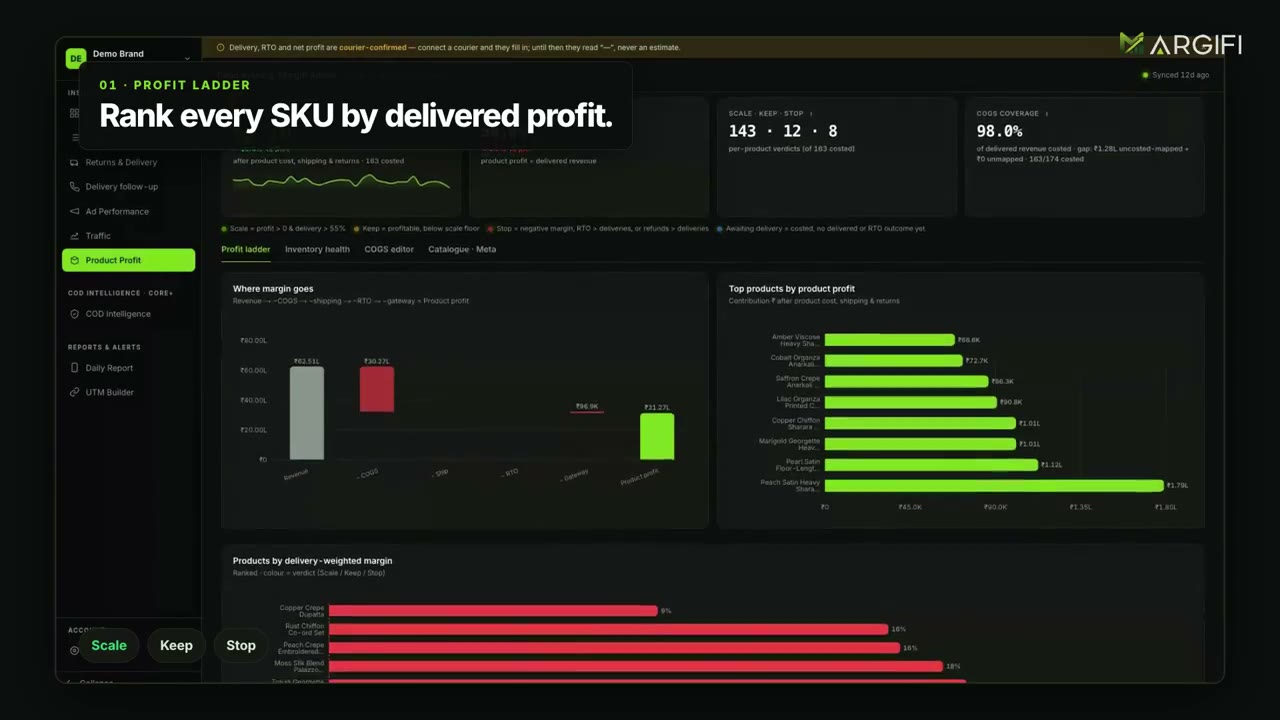
Blended margin hides it: a top mover on units sold can be a net loser once returns and COD-RTO net out, while expiry-dated stock quietly turns into dead inventory. In a typical catalogue ~25–30% of SKUs are negative-margin 'zombies' you keep restocking and advertising. Margifi ranks every SKU by delivered profit — Scale / Keep / Stop — with per-SKU RTO, prepaid share and expiry-aware dead-stock value, so you cut duds and reinvest into the SKUs that land and get kept.

  • Catalogue / DPA product-level delivered profit — real margin per product after returns, not blended Live
  • Per-SKU delivered-profit ranking (Scale / Keep / Stop) + per-SKU RTO / delivery / prepaid share
  • Expiry-aware dead-stock value & days-of-cover — FEFO before write-off
app.margifi.com/b/your-brand/sku
Products & catalogue — Wellness & supplements

Meta was showing me 4.2x on my whey and multivitamin campaigns, so I kept scaling. Then I reconciled the bank — after COD returns and the stock I had to write off, I was barely at 2x. Half my 'best' orders were bouncing in the same five pincodes.

Wellness & supplements founderillustrative

Illustrative — a category benchmark, not a single brand's numbers.

Questions

Margifi for wellness & supplements — FAQ

Because Meta counts booked orders, and wellness runs 60–80% COD. Once you strip 20–40% Meta inflation (view-through, cross-device) and ~26% COD RTO, delivered ROAS on a reported 4x lands closer to 2x. Margifi computes ROAS on courier-confirmed delivered revenue, so you scale on money that actually arrived.

See your real delivered profit, wellness & supplements.

Connect Shopify and Meta and watch order ROAS become delivered ROAS — net of every RTO.

1-week free trial · first charge after trial