Home decor & furnishings D2C

A 3.5× ROAS on a 3% margin isn't safe. It's glass.

High AOV is the trap: ₹15k–50k orders make a 3.5× look bulletproof, but after COGS, volumetric freight, gateway fees and ad cost, benchmark contribution is ~3% an order — one refund flips it negative. Then ~1 in 4 orders returns to origin, the courier bills the empty air in the box both ways, and a mirror that comes back cracked is COGS plus two freight legs, not a restock. Margifi recomputes every campaign on courier-confirmed delivered revenue, costed at the shipping and return rates you enter.

Start your free week1 week free · first charge after trialSee a live brand
  • ~3% contribution on ₹15k–50k AOV — one refund or one broken lamp flips the order negative.
  • Bulky-but-light decor bills on volumetric weight, and discrepancy charges auto-deduct in 7 working days.
  • A ceramic, glass or mirror return that arrives damaged is a full write-off: COGS + both freight legs.
Order → Delivered ROAS2.63×from ~3.5× bookedEstimated
Contribution margin per order3%one refund flips it negativeEstimated
All-in loss per returned COD order₹350₹180–350 — bulky decor tops the rangeEstimated
Weight-discrepancy deductions₹2000per ~1,000 shipments — 7 days to disputeEstimated

Typical Indian home decor & furnishings benchmark ranges — your real numbers will differ. Category benchmarks — not Margifi results.

Profit truth

High AOV is how decor founders scale a 3% margin into a large loss

The screen says 3.5× on a ₹4,000 lamp and it feels like a business. The ledger disagrees: after COGS, volumetric freight, gateway fees and ad cost, benchmark contribution is ~3% an order — and Meta CAC is ₹502 and up 32% year on year. Both Meta and Shopify book the order the second checkout completes, so the quarter of parcels that come back are still credited to the campaign as sales, and freight hits your P&L at the courier's volumetric number, not the rate card you budgeted. Margifi rebuilds every campaign on courier-confirmed delivered revenue, costed at the shipping rates you set, so the 'winner' that books cheap and delivers broke stops getting scaled.

  • Delivered ROAS on courier-confirmed revenue, with the order-vs-delivered gap surfaced per campaign
  • Profit waterfall on your own cost inputs: revenue → COGS → shipping + returns → ad spend → net
  • Delivered CAC — what an order that landed and got paid for actually costs, vs the order CAC Meta reports

Returns & RTO

The courier bills the air in the box — then bills it again on the way back

Rugs, lamps, planters and framed art are light but bulky, so couriers bill on volumetric weight: 500g–1kg discrepancies per shipment, ₹500–2,000 in surprise charges per thousand shipments, auto-deducted unless you dispute inside 7 working days — and those deductions land at the account level, never against the SKU the ad sold. Then the RTO doubles it: a returned bulky COD order runs ₹180–350 all-in, and if the mirror comes back cracked there is no restock — product cost, both freight legs and the damage-claim fight are all yours. Margifi computes return loss at the reverse-freight and restock rates you set, and pins it to the exact ad, SKU and route.

  • NDR + Out-for-Delivery calling worklist — the shaky in-flight COD orders to call or WhatsApp-confirm today, ranked by rescue value and pincode risk Live
  • Return-loss at your reverse-freight and restock rates, pinned to the ad and SKU that caused it
  • Fragile SKUs isolated — ceramic, glass and mirror lines carry their own return costs per SKU instead of hiding in a blended returns line

COD reliability

A ₹4,000 COD lamp at the doorstep is a loan you made to a stranger

Decor buyers lean COD on tactile, high-ticket items they've only seen on a phone screen — and COD is where RTO explodes: 20–30% versus 10–15% prepaid, in a category where a successful COD order already costs ~₹200 to fulfil against ~₹100 prepaid. A doorstep refusal on a bulky parcel means both freight legs at volumetric rates plus repacking, and 'looked smaller than the photo' is all it takes. Everyone's advice is push prepaid; nobody tells you which lanes are the actual risk. Margifi reads COD reliability by region and pincode from your own courier truth, so the handful of bleeding lanes get gated and the reliable Tier-2 buyer keeps their COD.

  • COD RTO rate by region and pincode, courier-confirmed — gate the pincode that bleeds, not the whole state — plus the quantified COD→prepaid upside
  • Net margin after every RTO — both freight legs at the rates you set, booked the day the parcel bounces
  • The COD premium made explicit: fulfilment cost, refusal risk and double freight set against decor's high order values

Products & catalogue

Your best-selling mirror is probably your worst SKU

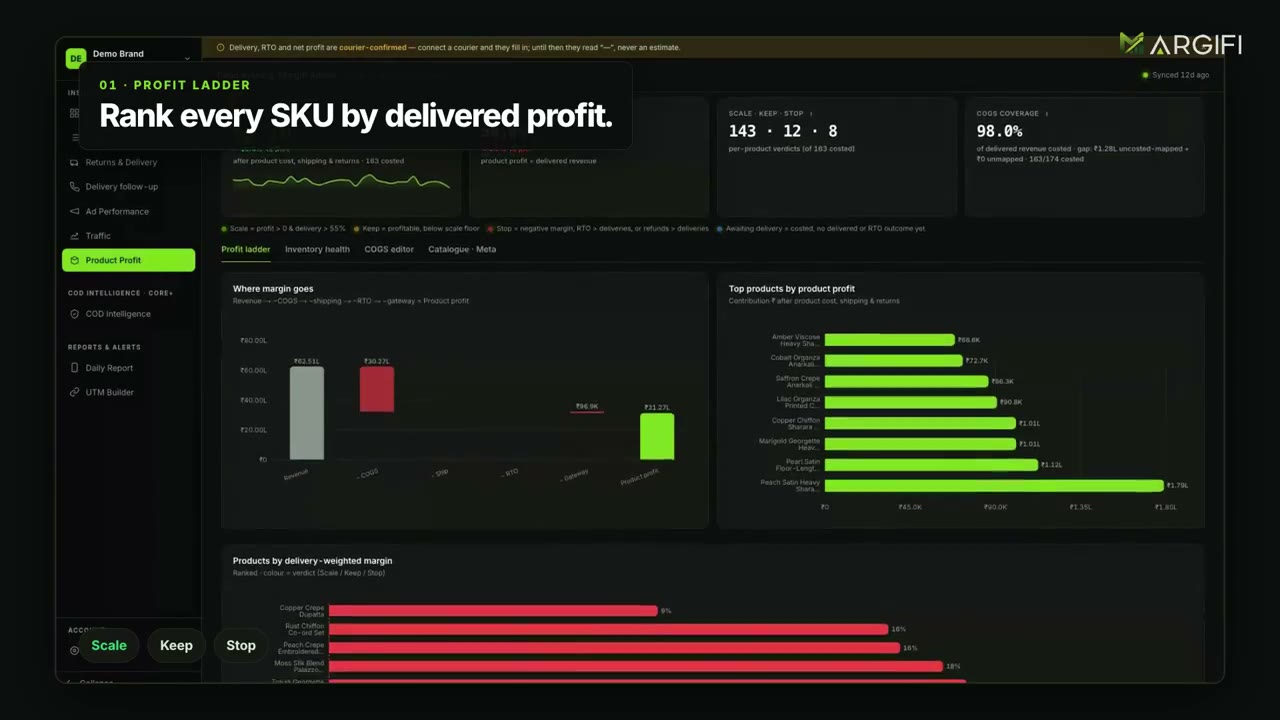
Blended margin says the catalogue works; the SKU ledger says a units-mover can be a net loser once breakage, double freight and 'looked different on screen' returns net out. Colour, texture and scale don't survive a phone screen, so those returns cluster on specific SKUs — and you keep buying traffic to them, because catalogue/DPA feeds spread spend across everything, including negative-margin pieces. Meanwhile bulky slow-movers sit as dead stock, eating warehouse space and working capital. Margifi ranks every SKU by delivered profit and computes catalogue economics per product_id, so the losers come out of the feed and the reorder budget follows the winners.

  • DPA / catalogue product-level profit — spend, delivered ROAS, RTO and delivered profit per product_id; prune loss-making SKUs from the feed Live
  • Per-SKU delivered-profit ranking (Scale / Keep / Stop) with return rate, return loss and prepaid mix
  • Dead-stock value and days-of-cover on bulky slow-movers — free the warehouse before the capital rots in it

Where home decor & furnishings usually lands

Meta order ROAS~3.5×Estimated
Delivered ROAS2.63×Estimated
Orders returning to origin~25%Estimated
Contribution margin per order~3%Estimated

Benchmark ranges for the category — the only real numbers we publish are from our live pilot.

See the live pilot brand

Margifi for home decor & furnishings — FAQ

Not from the courier's invoice — that ingest isn't built. Bulky-but-light SKUs really do bill on volumetric weight, and couriers auto-deduct discrepancies if you don't dispute within 7 working days, but Margifi costs delivered margin using the shipping and return rates you enter in Settings. Set them to your realised volumetric rate rather than your rate card and the margin you see is the margin you earned.

See your real delivered profit, home decor & furnishings.

Connect Shopify and Meta and watch order ROAS become delivered ROAS — net of every RTO.

Start your free weekFirst charge after trialSee a live brand