F&B & packaged food D2C
Your break-even ROAS is 4.5×. Meta calls 4× a win.
Break-even ROAS is 1 ÷ gross margin — at a typical 22% food margin, that's 4.5× before shipping, COD fees and returns. Meanwhile 30–35% of COD orders never deliver, FSSAI rules turn every returned parcel into destroyed stock, and each extra transit day — monsoon week or not — eats into the ≥45-day shelf-life window your stock must land with. Food's saving grace is the 2–3-week reorder cycle, but a repeat cohort only starts if box one arrives. Margifi recomputes every campaign on courier-confirmed delivered revenue and marks it against your real break-even line.
- Break-even = 1 ÷ margin. At 22% gross that's 4.5× — the '4× winner' is losing on every order.
- A returned food box is destroyed stock: FSSAI blocks resale, so it's COGS plus both freight legs.
- Food buyers reorder in 2–3 weeks — but only the ones whose first box actually arrived.
Typical Indian F&B & packaged food benchmark ranges — your real numbers will differ. Category benchmarks — not Margifi results.
Profit truth
Food runs D2C's thinnest margins against its lowest ad efficiency
The arithmetic nobody puts on a dashboard: break-even ROAS is 1 ÷ gross margin, food and FMCG run the lowest ad efficiency of any D2C category (2–3× MER), and a 22%-margin snack brand needs 4.5× before shipping, gateway and returns. Run the worked example — ₹1L of spend at 3× is ₹66k gross profit against ₹1L of ads: −₹34k, before a single box bounces. Heavy jars and tins make it worse: weight-based freight compresses margin fastest on exactly the low-AOV SKUs. Margifi recomputes every campaign on courier-confirmed delivered revenue and draws your break-even line on it, so a below-the-line 'winner' reads as what it is.
- Delivered ROAS per campaign, marked against your real break-even — not an assumed 1×
- Profit waterfall: revenue → COGS → weight-based freight + returns → ad spend → net, per campaign and per SKU
- Delivered CAC and delivered-margin CM:CAC per cohort — acquisition maths on boxes that landed and got paid for
Returns & RTO
A returned food parcel isn't inventory. It's a write-off with paperwork.
FSSAI doesn't just discourage reselling returned food — it mandates destruction and quarterly reporting, so every RTO is COGS plus both freight legs by law, and unsalvageable returns already run 15–25% in food versus 2–8% in apparel. The weather writes its own returns: a monsoon-week parcel that bounces between hubs for a fortnight comes back past the ≥45-day shelf-life window even with the seal intact, and summer transit does to ghee and chocolate what no repacking fixes. All of that loss usually books as one lump 'logistics' line. Margifi pins each destroyed unit to the exact ad, SKU and pincode that produced it — and works the in-flight orders before they become write-offs.
- NDR + Out-for-Delivery calling worklist — rescue the shaky in-flight COD orders inside the 24–72h window, before perishable stock dies in transit Live
- Return loss = reverse freight + the restock cost you set, charged to the exact ad and SKU that generated it
- RTO by zone and pincode heat — Tier-3 lanes bounce at 2–3× the metro rate; throttle them without choking Tier-2/3 volume
COD reliability
Your buyers reorder in three weeks. Your COD cash lands in ten days — if it lands.
Packaged food skews 60–70% COD, and COD is a triple tax: RTO at 2–3× the prepaid rate, remittance fees, and cash that arrives T+5 to T+10 against T+2 for prepaid — so contribution per COD order runs 40–60% below its prepaid twin. In a category whose whole model is the 2–3-week reorder, that cash lag starves the restock that funds the repeat. And the month's 'revenue' is part fiction: a slug of it is still in transit and some of it is coming back. Margifi scores COD risk by region and pincode before you ship, shows booked versus projected-landed revenue, and splits contribution by COD and prepaid cohort so the leak has a name.
- COD RTO rate by region and pincode, courier-confirmed — gate the lane that bleeds, not the whole state — plus the quantified COD→prepaid upside
- In-flight projection — booked → projected-landed after RTO and remittance, so this month's number is cash, not hope
- COD vs prepaid contribution per cohort — see exactly where the 40–60% margin gap leaks
Products & catalogue
Heroes stock out while the variety packs expire on the shelf
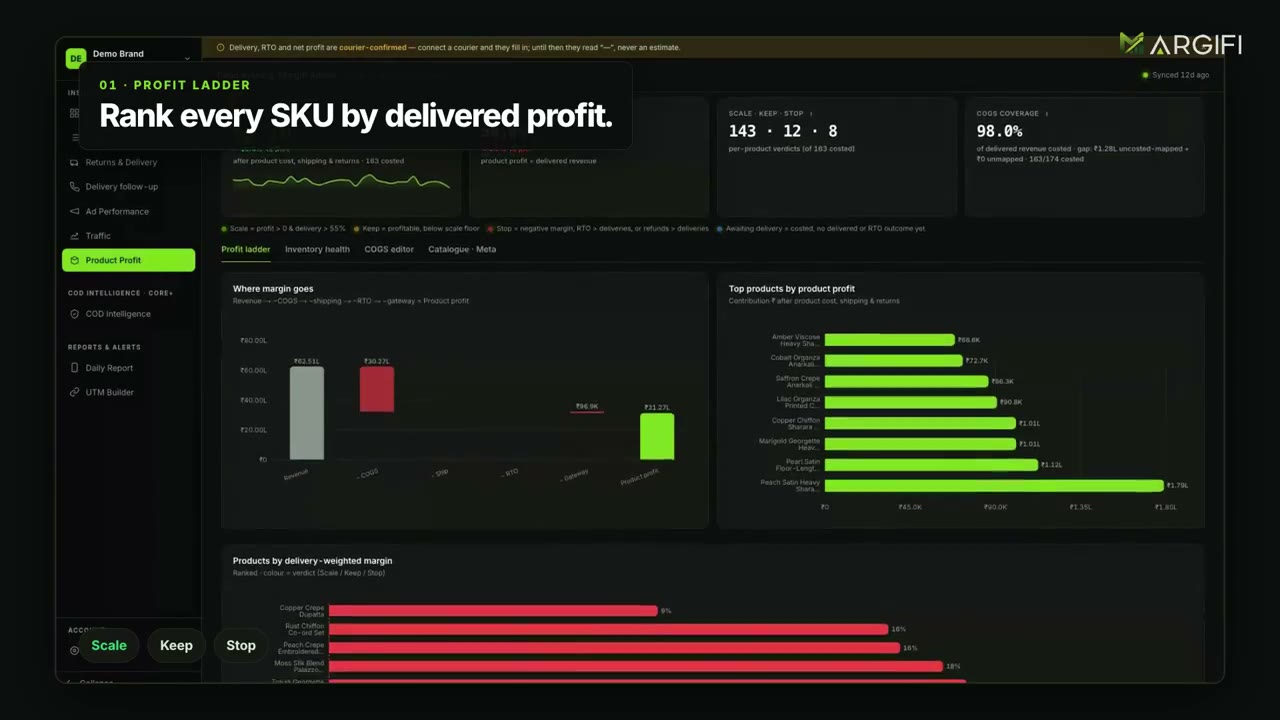
A food brand launches with three hero SKUs and wakes up carrying twenty — flavours, bundles, gift packs, heavy jars — and in food the dead-stock clock is a legal clock: FSSAI requires ≥30% or ≥45 days of shelf life at delivery, so a slow SKU crosses unsellable long before it looks old. Most brands find a majority of SKUs unprofitable to advertise while a few heroes carry the P&L, but blended ROAS can't say which is which — so budget keeps feeding the losers while the winner stocks out mid-reorder-cycle. Margifi ranks every SKU by delivered profit with days-of-cover and dead-stock value: the slow lines surface while there is still shelf life left, and reorders go where the delivered demand actually is.
- Per-SKU delivered margin (Scale / Keep / Stop) with a delivered-demand reorder signal — restock heroes before they stock out
- Dead-stock value and days-of-cover per SKU — spot the slow lines before another production run goes out
- DPA / catalogue product-level profit per product_id — prune the SKUs that sell, bounce and expire out of the feed Live
Where f&b & packaged food usually lands
Benchmark ranges for the category — the only real numbers we publish are from our live pilot.
Margifi for f&b & packaged food — FAQ
Because break-even ROAS = 1 ÷ gross margin. At a typical ~22% food margin you need 4.5× just to cover ad spend — before shipping, COD leakage and returns. Layer on a 30–35% RTO where each returned unit is a total write-off, and a 4× reported campaign is often deep in the red. Margifi recomputes ROAS on courier-confirmed delivered revenue per campaign and shows it against your real break-even line, so 'winning' means above the line, not above zero.
See your real delivered profit, f&b & packaged food.
Connect Shopify and Meta and watch order ROAS become delivered ROAS — net of every RTO.