Fashion accessories D2C

At a ₹600 AOV, an RTO isn't a shipping line. It's the whole order's profit.

Belts, sunglasses and wallets are impulse COD buys — placed without commitment, refused without cost. 28–35% of those orders never deliver, and every bounce deletes ₹180–350 in round-trip freight and repackaging: 30–60% of a typical accessory's order value, more than most SKUs' entire margin. At 2,000 COD orders a month that's ₹9–17 lakh leaving quietly. Margifi recomputes every campaign on courier-confirmed delivered revenue and charges each RTO back to the ad and SKU that caused it.

Start your free week1 week free · first charge after trialSee a live brand
  • ₹180–350 round-trip loss per refused order — 30–60% of a typical accessory AOV.
  • COD runs 45–65% of orders, and 28–35% of it never completes delivery.
  • The pixel keeps teaching Meta to find more of the buyers who refuse at the door.
Order → Delivered ROAS2.0×from 3× bookedEstimated
COD share55%Estimated
COD RTO rate30%vs 2–8% prepaidEstimated
RTO loss vs AOV40%₹180–350 on ₹600Estimated

Typical ranges for COD-heavy Indian accessories brands — your real numbers will differ. Category benchmarks — not Margifi results.

Profit truth

The pixel is training Meta to find your refusers

Meta optimizes on the Purchase event, and the pixel fires on order-placed — so the algorithm learns the traits of everyone who checks out, including the 28–35% of impulse COD buyers who will never pay, and goes looking for more of them. You end up scaling budget into a feedback loop that actively worsens delivery quality, on a delivered ROAS 30–40% below the number in Ads Manager. On 15–25% contribution margins there's no buffer to absorb that — the 'winning' campaign is often the one manufacturing your RTO bill.

  • Delivered ROAS per campaign — recomputed on courier-confirmed delivered revenue and reconciled daily against what Meta booked.
  • Delivered CAC vs order CAC — what a paying customer really costs once the refusers are stripped out.
  • Profit waterfall: revenue → after COGS → after shipping & returns → after ad spend → net.

Returns & RTO

'The colour looked different' — the return no size chart can prevent

Accessories don't come back over fit — they come back over expectation: the colour, material or scale didn't match the edited on-model shot. Bags and belts run ~12% returns and fashion jewelry 10–15%, and each refused order deletes ₹180–350 in forward freight, reverse freight, repackaging and locked capital. The creative that oversold the product never gets the bill — so you keep scaling the exact ad that manufactures the returns.

  • NDR & Out-for-Delivery worklist — call or WhatsApp the save-able orders inside the 24–72h window, ranked by rescue value and pincode risk. Live
  • Return loss charged back to the exact ad and SKU — reverse freight plus the restock cost you set, not a lumped shipping line.
  • Return-reason attribution per SKU and campaign — find the creative that keeps overselling the colour.

COD reliability

Half your orders are COD, approved blind, remitted weeks later

Belts, sunglasses and wallets are impulse Tier-2/3 buys placed on COD with zero commitment — and 28–35% of those orders never complete delivery. With no lane-level signal at dispatch you ship into repeat-refusal pincodes with no warning. Then the cash-flow tax lands: COD remittance arrives 2–14 days after delivery, and every RTO is inventory riding the network for two weeks with zero revenue against it. A revenue-minus-COGS view shows neither.

  • COD RTO rate by region and pincode — screen the refusal-heavy lane before the parcel ships, not after it bounces.
  • COD → prepaid nudge sizing on risky orders and pincodes — without choking the Tier-2/3 buyers who convert.
  • Profit waterfall with the in-transit view — the cash still riding the network, not just booked revenue.

Products & catalogue

Your bestseller is fast-moving, thin-margin and quietly net-negative

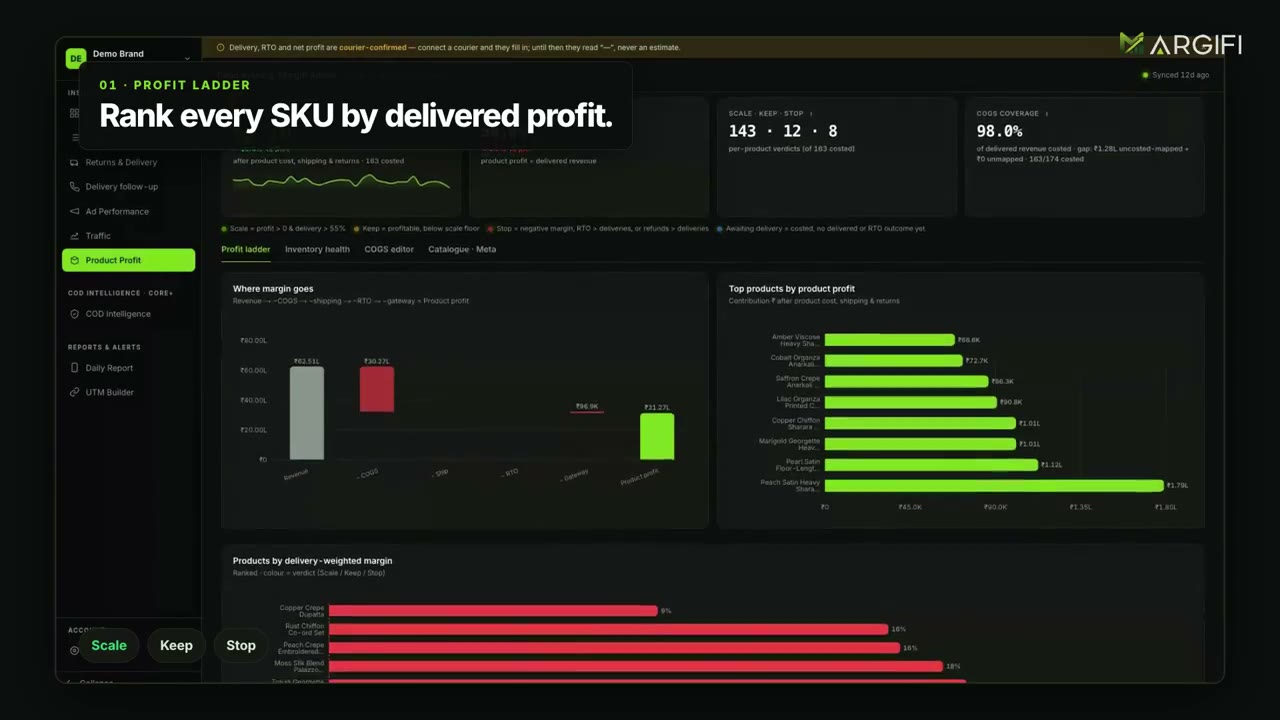
Accessories run 15–25% contribution margins, and a ~12% return rate is enough to flip a fast-moving SKU below zero once reverse freight and ad cost load onto it — a units-sold ranking can't see that. Meanwhile your catalogue/DPA feed spreads spend across the whole range, including the SKUs that 'sell' and then bounce. Margifi matches every order to its catalog product_id and computes delivered profit per product, so the feed stops funding the losers.

  • Catalogue / DPA product-level profit — spend, delivered ROAS, RTO and delivered profit per product_id; prune the losers from the feed. Live
  • Per-SKU delivered-profit ranking with Scale / Keep / Stop verdicts — down to the colour and variant.
  • Dead-stock value & days-of-cover — stop restocking the thin-margin SKUs that lose money delivered.

Where fashion accessories usually lands

Meta order ROAS3.0×Estimated
COD RTO on impulse orders28–35%Estimated
Delivered ROAS~2.0×Estimated
Round-trip loss per bounce₹180–350Estimated

Benchmark ranges for the category — the only real numbers we publish are from our live pilot.

See the live pilot brand

Margifi for fashion accessories — FAQ

It's bigger for you than for anyone. The ₹180–350 round-trip cost of a refused COD order doesn't scale down with your price — on a ₹600 AOV it's 30–60% of the order's entire value, usually more than the SKU's margin. At 28–35% COD RTO, that's what turns a booked 3× into a delivered 2×.

See your real delivered profit, fashion accessories.

Connect Shopify and Meta and watch order ROAS become delivered ROAS — net of every RTO.

Start your free weekFirst charge after trialSee a live brand